Home Safety · National
How Can I Make My Stairs Safer at Home?

Emily Carter, OTR/LNov 10, 2026 · National
The short answer
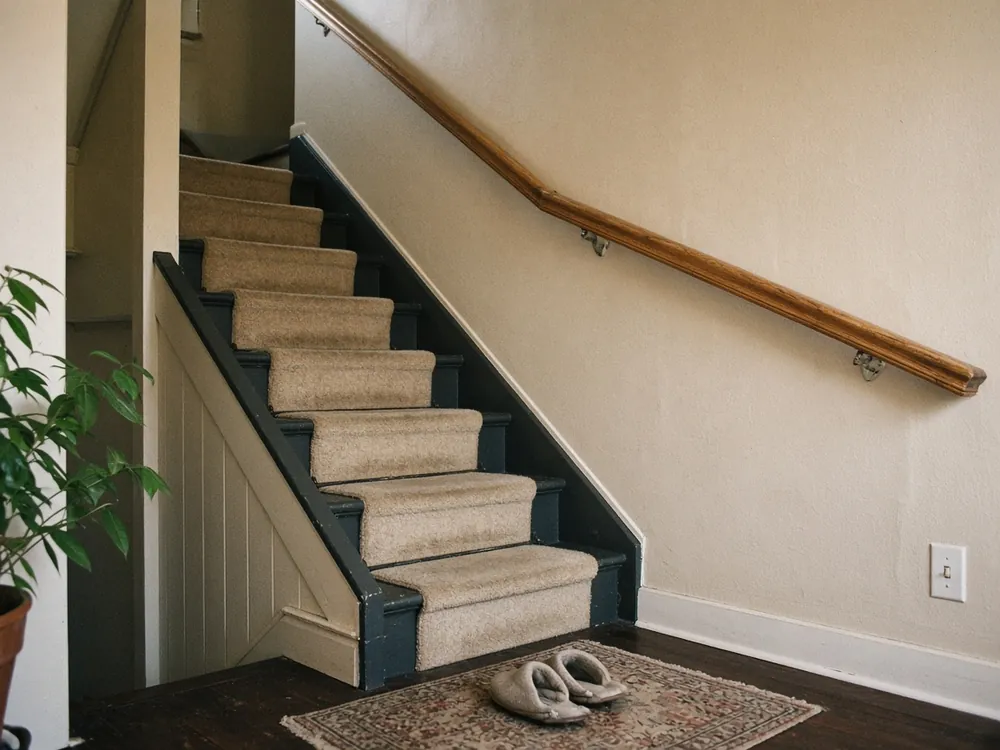
Start with the basics that public home-safety checklists from the CDC and the National Institute on Aging put first: secure handrails on both sides of the stairs that run the full length, a light and a switch at both the top and bottom, nothing left on the steps, and carpet or treads that are firmly fixed. If someone has already fallen or feels unsteady on stairs, ask their doctor about an in-home look from a licensed occupational therapist.
Stairs are one of the places where a small problem — a loose rail, a burned-out bulb, a pair of shoes left on a step — can turn into a fall. The good news is that most of the fixes are simple and many cost little. This guide walks through the stairs the way an occupational therapist tends to: not only “is the staircase safe?” but “how does this person actually use it, carrying what, at what time of day?”
The CDC reports that more than one in four people aged 65 and older fall each year, and that broken or uneven steps are among the home hazards that make a fall more likely. Stairs deserve a careful look.
1. Handrails: both sides, full length, solid
A handrail is the single most useful thing on a staircase, and it only helps if it is there when the hand reaches for it.
- Both sides. The CDC’s home checklist recommends handrails on both sides of the stairs. That way there is always a rail on the stronger side, going up and coming down.
- Full length. Rails should run as long as the stairs, so there is something to hold on the first and last step — where many people lose their footing.
- Secure. Grip the rail and pull. If it moves, flexes or rattles, fix it before anything else. A loose rail can be worse than none, because people trust it.
- Easy to grip. A rail the hand can wrap around is easier to hold than a wide flat board. If a rail is hard to grip, a contractor can add a rounded rail alongside it.
- Actually used. The National Institute on Aging (NIA) advises holding the rail every time, even when carrying something. That is a habit worth practising, not just a fixture worth installing.
2. Lighting you can reach from both ends
Many stair falls happen in poor light: going down at night, or coming in from a bright outdoors into a dim hallway.
- Have a light and a switch at the top and the bottom of the stairs, so nobody has to climb in the dark to reach a switch. The CDC suggests having an electrician add them where they are missing; switches that glow are easy to find at night.
- Replace burned-out bulbs straight away. If changing them means climbing a ladder, ask a friend or family member to do it.
- Consider plug-in, motion-activated night lights along the route people use at night, for example from the bedroom to the bathroom. The NIA mentions these as a simple way to light stairways and paths.
- Avoid glare. A bare, bright bulb at the bottom of the stairs can make the steps harder to see, not easier.
3. Steps that are clear and easy to see
- Nothing on the stairs. Books, laundry, shoes and bags left “to take up later” are a classic trip hazard. Agree on one spot at the bottom for things going up.
- Fixed surfaces. Carpet should be firmly attached to every step. If it is loose or torn, fix it, or take it up and use non-slip treads, as the CDC checklist suggests.
- Repair broken or uneven steps. A step that is a different height from the others, or that rocks, is easy to misjudge.
- Visible edges. The AOTA and Rebuilding Together home checklist suggests a color contrast or texture change at the top and bottom stair edges, which can help people whose eyesight is changing see where each step ends.
4. Outdoor and entry steps count too
Steps up to the front door, down to a garage or out to a patio are often forgotten. Check them for the same things — rails, light, a firm and even surface — and add the outdoor extras the NIA lists: non-slip material on outdoor steps, a clear path free of leaves and branches, a porch light that is on when you get home after dark, and, in winter, ice melt or sand on walkways.
5. How the person uses the stairs
This is where an occupational therapist’s view is different from a contractor’s. The same staircase can be fine for one person and risky for another. Questions worth talking through:
- Does the person carry things up and down — laundry baskets, groceries, a cup of tea? Carrying blocks the view of the steps and takes a hand off the rail. A basket left at each level, or a bag worn across the body, can help.
- How many trips a day are really needed? Sometimes moving a few daily items (a second set of toiletries, a phone charger) saves several trips.
- Does the person rush to answer the door or the phone? Keeping a phone in a pocket removes one reason to hurry.
- Has the person been dizzy when standing up, or changed medicines recently? The NIA notes that some medicines can cause dizziness and that getting up too fast can make you feel wobbly. That is a question for their doctor or pharmacist, not something to manage alone.
- Would it make sense to live mostly on one floor? For some households, a bedroom and bathroom on the entry level is the biggest single change. That is a bigger decision to make together with the person, their family and their clinicians.
Quick stair safety checklist
- Handrails on both sides, full length, firmly fixed
- Light and switch at the top and bottom; no burned-out bulbs
- Night lighting on the route used after dark
- Nothing stored or left on the steps
- Carpet fixed down, or non-slip treads instead
- No broken, rocking or uneven steps
- Step edges easy to see
- Outdoor steps lit, clear, non-slip, and treated in icy weather
- A phone carried, so nobody rushes on the stairs
When to get a professional opinion
The NIA notes that after a fall, a doctor might suggest that an occupational therapist, physical therapist or nurse visit the home to assess its safety. That is worth asking for if someone has fallen on the stairs, avoids them because they are afraid, needs to stop and rest partway up, or holds on to the wall instead of the rail. A licensed occupational therapist can look at the person and the home together and suggest changes that fit both. For building work — new rails, rebuilt steps, a stair lift — use a licensed contractor.
If someone falls and hits their head, the CDC advises seeing a doctor right away. If someone is hurt or in danger, call emergency services.
Frequently asked questions
Do stairs really need a handrail on both sides?
Public checklists from the CDC and AOTA with Rebuilding Together both recommend rails on both sides. It means there is always a rail on the person’s stronger side, whether they are going up or coming down, and a free hand on each side if they need it.
What is the cheapest change that makes the biggest difference?
Often it is light: replacing burned-out bulbs, adding plug-in motion night lights along the night-time route, and keeping the steps completely clear. These cost little and can be done the same day. Loose rails are the urgent exception and should be fixed first.
Should we remove the carpet from the stairs?
Not necessarily. The CDC checklist says to make sure carpet is firmly attached to every step, or to remove it and use non-slip treads instead. Loose or torn carpet is the problem, not carpet itself.
Is a stair lift a good idea?
It can be for some people, and not for others. Whether it fits depends on the person’s abilities, the staircase and the household. Talk it through with the person’s doctor and, ideally, an occupational therapist before buying one.
When should we ask for a home safety assessment?
After a fall, when someone is afraid of the stairs or has started avoiding them, or when you notice them struggling. Ask their doctor whether an in-home visit from an occupational therapist makes sense.
Sources
- CDC: Facts About Older Adult Falls
- CDC STEADI: Patient & Caregiver Resources (includes the “Check for Safety” home checklist)
- National Institute on Aging: Preventing Falls at Home: Room by Room
- National Institute on Aging: Falls and Fractures in Older Adults: Causes and Prevention
- AOTA and Rebuilding Together: Aging in Place / Safe at Home Checklist (PDF)